Tuesday, November 11, 2014

Education in Kenya: Who wants to be a Professor anyway?

Courtesy of: http://www.outsidethebeltway.com
An interesting spectacle unfolded during the last three days of last week as I attended a doctoral supervision training course at UFS (University of the Free State Bloemfontein) aimed at strengthening and enhancing the quality of doctoral research in South Africa. It suddenly dawned on me that a society’s values are best measured depending on where its money is invested. Suffice to note that a good number of developed economies invest a colossal sum of their money in building human capital through educational programmes. The inverse is true for developing countries whose resources seem to get wasted through political leaders hell-bent on attaining highest honours on self-aggrandisement and economic enrichment.
For example, Kenya has a small number of quality doctorates in relation to its population compared to a preferable sample ratio of 100 doctorates per one million individuals. The trickledown effect is that educational standards are adversely affected. As a result, instead of having the most qualified personnel teaching pre-schoolers and early grade children, the reverse is witnessed. In Kenya, the more qualified you are, the less likely you are to teach lower cadres of students. Indeed, most professors are stuck in teaching doctoral students, or handling administrative tasks, thus denying young scholars the opportunity to benefit from their knowledge.
In an ideal environment, a professor should be the one teaching children and helping to nurture and horn the educational skills of a future generation. However, in most developing countries, this task is delegated to people who failed in school because the career is associated with poor pay and lack of respect or recognition. It is thus not surprising to realise that there is a dialectic relationship between the quality of education amongst the majority of people who happen to be poor and their masterly of language skills or other pedagogical matters.
On the contrary, those who can afford to enrol their children in expensive schools, begin to reap the benefits of a quality education system that, so to speak, unfairly advantages their children over those from poor backgrounds. Essentially this means that expensive schools have the capacity to attract and retain highly qualified personnel as opposed to public schools that have to rely on meagre government funding. Thus, it might be possible to surmise that our educational system is large and by responsible for exacerbating the social stratification of our nation.
Image Courtesy: http://www.google.com/imgres
What would it take for a country like Kenya to have qualified professors to teach kindergarten kids? As it is, many undergraduates will finish their first degree without imbibing or sipping from the fountains of professors’ wisdom. And therein lies our educational tragedy. I am not in any way postulating that people with master’s degrees or PhD’s are not qualified, no way! My argument is simply meant to underscore the fact that the years invested in research and dissemination of knowledge percolates into the making of the individual thereby making him/her a better academician.
Besides, if the Kenyan educational environment was conducive, apportioning adequate resources in terms of time and money, many people would venture into the profession. Unfortunately, being a teacher in a Kenyan context is something that most of us disdain and look down upon. There is no question that societal demands have pushed many a young person to escape the academic path lest they wallow in eternal miasmic conditions of poverty. It is thus prudent for us to rethink the values of education and to appreciate the different demands that societal responsibilities will exert on us. In this way, we will equip ourselves with different skills and pursue different careers with our heads held high.
Indeed, we need to re-invest in the education sector. We need to retrain our children that education is important. Although there are high achievers in the society who are school dropouts, our children need to be in the know that pursuing education does not mean putting one’s goals to an end. Rather, it means that education becomes a means to help them to better focus and crystallise their vision and goals. Maybe it is high time we stopped being paranoid about education and respected this noble profession if we actually belief in the sanctity of human growth and a holistic society.

Back to by doctoral supervision course. At least I learnt one important issue regarding power play in connection to supervision – education can make or break someone’s future! Consequently, if we are not careful, our educational pursuits as a country will end up breaking our kids’ souls instead of transforming them into inspired qualified beings capable of discovering innovative solutions to our social, political and economic woes. I hope that the next time we talk to our kids about what they want to be when they grow up we will think about the need for a quality educational system that can propel them to be what they visualise in their dreams and fantasies. 

Wednesday, October 15, 2014

Trauma in Benjamin Garth Bundeh’s Birds of Kamiti

Imprisonment can be a traumatising affair. It is especially so if you are convicted and sentenced to death row and compelled to witness the hanging of fellow convicts as the clock tick tocks and your hour of reckoning draws nigh. This is what Benjamin Garth Bundeh discovers when the police pick him up and hold him for the suspected murder of an old white businessman, Mr Nigel Fawssett. Fawssett happens to have been Bundeh’s business associate before his demise as narrated in Bundeh’s text.

Birds of Kamiti is the memoir of Bundeh in which the writer adopts a persona to remember the events connected with his arrest and subsequent conviction for the murder of Fawsset. The writer uses the memoir genre to help him memorialise the dark events connected with his years in death row. Although his experience is one that can be described as unspeakable and one which the writer would rather forget, he has to relive the trauma – to remember the painful details; hence, he has to confess (publicly through the writing of his story) what happened to him so that he can begin his traumatic healing.
This text highlights the pain that those who are convicted for crimes that they have not committed go through. It seeks to demonstrate that police can and sometimes do connive to adduce trumped up charges against suspects and have them incarcerated for crimes they have not committed. This is the fate that befalls Bundeh. It is a narrative that emblematises failed judicial processes in Kenya and Africa at large. Indeed, Bundeh’s story is reminiscent of political detentions and torture of the infamous Nyayo Torture Chambers linked to the leadership of the former President of Kenya – Moi.   
Bundeh’s memoir thus seeks to reconstruct the events of the persona’s life before and after his conviction. Narrated in retrospect, the story highlights the persona’s struggle to repudiate the police evidence against him when he lodges an appeal in the hope that justice can be meted out to him. While serving his time in death row, the persona encounters the debilitating effects of capital punishment and the terror it unleashes on the human soul. The horrendous events that unfold at Kamiti are despicable and they attest to the animalistic tendencies that human beings are reduced to when subjected to dehumanising conditions.
He becomes a witness to the massacre of convicts through the hanging of specifically those that had been convicted for the attempted coup d’état of 1982 in Kenya. It is a harrowing period that the persona and other inmates have to endure as one by one the convicts are picked up by the hangman. The hanging of their fellow inmates traumatises them and leaves them with indelible psychological wounds that demand therapy to heal. Indeed, bearing witness to the death cries of fellow inmates is not anyone’s wish! The imagination that a living soul you have been sharing space with is no more is almost unfathomable. Thus, the psychological exertions of death row end up painfully bruising the human psyche of prisoners thereby drawing the reader’s empathy for those that are unfortunate to endure or later succumb to such experiences.
Police injustice and violence is vivified through their handling of the prisoners. First, they torture the protagonist and force him to sign blank papers which they later fill up with falsified evidence which they then use against him in court. Second, their arrogance is evidenced in the way they threaten Bundeh and how they handle the prisoners during body searches for contraband. Hence, they come across as dehumanised and the reader is persuaded to distance himself/herself from their callous behaviour. Such methods of coercion are not uncommon in Kenyan cells. One wishes that the judiciary would treat evidence collection methods with a tinge of suspicion!
Besides, the justice system is cast as corrupt and open to manipulation. The fact that the judge, in Bundeh’s case, fails to interrogate the assumed signed confession of the suspect is a good pointer to the unprofessional manner in which the Kenyan courts are at times run. At least the reader is convinced to empathise with the persona and his predicament when the judge sentences him to death because he appears genuine in his rhetoric. This is made possible through the juxtaposition of his confession vis-à-vis that of the police which is adduced in court. Thus, the reader rejects the police evidence as it is more of an admission than a confession because it is extracted from the persona through torture as opposed to wilful disclosure.
Bundeh’s breakthrough happens when he conducts his appeal and gets acquitted for the murder of Fawssett. He regains a sense of self-worth although he harbours bitterness towards the government for unfair imprisonment. This pain and bitterness is a major hindrance to his emotional and psychological healing and recovery. However, he finds a sense of closure about the death of some of his colleagues through the assurance that the birds of Kamiti keep vigil over their graves. His testimony is symbolic of the victims of unjust legal systems whose stories are cast into oblivion through capital punishment and subsequent death.  


Tuesday, September 23, 2014

A Lifetime Adventure as Narrated in "Why We Took the Car" by Wolfgang Herrndorf

Teen literature is often rife with adventure and a spirit of romance. Most texts that target teenagers teem with narratives that recount escapades, breathless moments, investigative pursuits and encounters with the unknown world amongst other aspects. This is best captured through the lenses of Mike Klingenberg, a fourteen year old boy, who clutches at a lifetime opportunity to make sure that his life will never be the same again.
Mike and his classmate, Andrej Tschichatschow, are the typical boring classmates whom no one wants to associate with. It is even worse for Mike who thinks that he writes great essays, he can do the high jump better than any other boy in his class and better still he can draw great images. At least, Tschick is the odd one out because he is perpetually drunk and he doesn’t care about anyone; even when the teachers make fun of him he is less interested.
However, the lives of the two young boys inevitably change when they are denied invites to Tatiana’s birthday party. It is a big blow to Mike who has a secret crush on her; he has even drawn a great Beyoncé image for her as a gift. Tschick manages to drag Mike for a road trip on a stolen car after they have dropped the drawing at Tatiana’s party rendezvous.
Theirs is a road trip like no other. Tschick is just learning how to wire cars and has not mastered the driving skill. Although Mike has been instructed by his father and left alone at home because his mother has made the umpteenth visit to the rehab centre, he jumps onto the idea and begins to visualise a world of infinite possibilities.
It is a journey that begins from Mike’s home and ends exactly there. Although the two of them are clueless of where to go, they decide to head towards Wallachia – a destination that is almost fictitious and non-existent. It is a trip that comingles with their encounters with dangerous people, reckless driving, thrilling moments of being free to roam the world and the fear and anxiety of the unknown when the two of them get lost in mountains and forested areas.
Why we Took the Car is an exciting story interspersed with moments of suspense. At one moment we are worried when they run out of gas but a teenage girl, Isa, whom they bump into at a garbage site helps them siphon petrol. Thereafter, their first accident results from a reckless desire to outmanoeuvre a police car. Our breath is held when the car rolls almost a dozen times before it lands on its roof and the wheels are left spinning in the air. However, the story must uphold the spirit of heroism. Mike and Tschick survive with minor bruises.
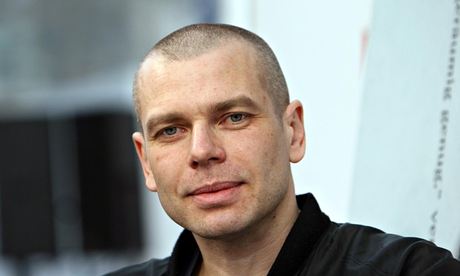
The late Wolfgang Herrndof (shot himself in Aug. 2013 after being diagnosed with cancer in 2010)
Read more about the author here: http://www.goethe.de/kue/lit/prj/lit/arc/b11/004/enindex.htm
But, their heroism is short-lived because a few pages later Mike crushes the car into a trailer ferrying pigs. Although Tschick is taken to juvenile court and Mike let loose, the boys have learnt their lessons and acquired new statuses and identities. This is best affirmed when their teacher, Wagenbach is proofed wrong about their road trip by the arrival of policemen to the school.

The narrative adopts simple language and uses humour to mock adults. This resonates well with teenagers because they dislike adults for meddling in their life affairs. Memorability is enhanced through descriptions like that of the hippo woman, Isa’s romantic moment with Mike, the countryside etc. It is a novel that teenagers will definitely love to read.  

Saturday, September 13, 2014

David Maillu’s "Man from Machakos"


Image courtesy of internet source
David Maillu is famed for titles such as My Dear Bottle, After 4:30, Unfit for Human Consumption, For Mbatha and Rabeka, and Benni Kamba 009 in operation DXT amongst many other titles.
As an author, Maillu has attracted controversy and fame in almost equal measure. Those who have read his texts would bear witness that they have at times been warned to keep off from his titles. This is owed to the fact that some readers consider the content of his books to be immoral. Others have commented that his style of writing is too explicit.
On the contrary, Maillu has penned down texts which should be of great interest to literary enthusiasts. Broken Drum is one of Maillu’s great achievements and it was extensively studied by Evan Mwangi, currently an Associate Professor at Northwestern University USA. Others are Kisalu and His Fruit Garden and Other Stories and also Man from Machakos.
Man from Machakos is a postmodernist text that provides a confluence of cultural, political and economic ideas. It is the story of Kivindyo whose name symbolises a true Mukamba – a native or if you like an indigenous Kamba man. His story is representative of the plight of jobless youth who look up to the government to provide them with jobs. But, Kivindyo’s realisation about the state of affairs concerning jobs and employment is not only daunting but utterly devastating.
His one desire is to join the Kenyan army and to settle down with the love of his life Mbeleete. Unfortunately, his bid to join the army is unsuccessful. Thus, he misses the golden opportunity to impress Mbeleete and it is, ironically, his arch-rival Justus Mwaka who wins the heart of the beautiful woman. It is a story that puts materialism into focus and castigates both men and women who build their relationships around material things. Read more about Maillu: http://www.davidgmaillu.com/
Kivindyo’s broken heart plunges him into self-deprecation and it takes his father’s scathing words to draw him out of self-pity. His father has a way with words, proverbs and he sometimes even indulges in silence as a form of communication. He is characterised as a wise old man whose wealth of experiences and knowledge is unsurpassed in the whole of Kyevaluki. He summons Kivindyo one night and bequeaths him with crucial Akamba people totems: a bow, a quiver of arrows and a traditional stool.  
Thereafter, he demands that the son should man up and stop whining like a bum. Kivindyo’s father – Mweleli son of Nguso – also gifts him with his only billy-goat and proffers a wealth of Akamba people’s wisdom inherited over the years upon his son. Thus, it would appear Maillu exploits the stereotype that Akamba people are honest and hardworking to fashion out the life of Kivindyo – the novel’s protagonist.
Working fastidiously, Kivindyo employs himself and manages to demystify the myth that people should always wait upon the government to help them. He transforms the lives of his fellow villagers, countrymen and even those beyond Kenya. The text suggests that personal initiatives are important but it also underlines the importance of moral and economic support in the quest for self-reliance. One of the key people who helps to nurture Kivindyo’s dreams is Munuka a learned man working in Nairobi.
The moral implications of Kivindyo’s resilience are substantiated in Lusia’s, Mukambi’s and Justus’s character transformation from a life of helplessness to one of enviable economic standing. Thus, Man from Machakos is an allegorical text that posits that we can forge a tribeless Kenyan nation of honest, hardworking people who abhor greed, hate and selfishness.

PS: This article was first published by The People Daily and is available here: http://mediamaxnetwork.co.ke/peopledaily/?p=102015

Monday, September 1, 2014

Why we should Read for Entertainment’s Sake

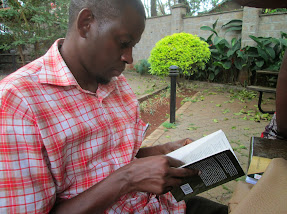
Reading "Dust" during a Daystar Book Club Meeting 
There have been substantial debates regarding the reading culture in Kenya today. Most of these discussions, if not all, squarely lay the blame on the current system of education and a generation Y that is allergic to reading. Whether such observations are true or not should not bother us so much as we should be by the lack of reading for leisure among the general populace.
When we hosted StoryMoja Festival’s Ideagasm session in Daystar University last week, I was confronted with startling remarks that jolted me back into the reality of what ails our reading culture. Some of the questions that were raised in the discussion included: What are we reading? What do we want to read? What are we writing? Why are we not telling our stories in film and in literature? What is the fear that plagues us?
The questions sparked off a spirited discussion that essentially accused the literary critic of not inspiring a critical mass of readers. Apparently, literary critics, I included, are fond of using complex theoretical phrases and diction that puts off general readers. I am not arguing that Kenyans lack the mental capacity to interpret such scholarly language but rather I am taking note that book reviews should be written in a way that would excite a majority of readers to yearn to read for fun.
A part of those present observed that Kenyan literary critics limit the scope of their audience by targeting each other. These critics hardly make any effort to describe the texts in simple and interesting approaches that would appeal to a wider section of Kenyans. As a result, most book reviews end up being counterproductive because the readers don’t see the texts as a source of entertainment.
Owing to the education system, most of us dislike literary texts because of the high school set books. The system is such that students are drilled to read to pass exams and the same applies to literature. With limited time for play and other leisure activities, the students develop a negative attitude towards reading thereby disliking literature as well. We cannot also discount the fact that books are expensive and that those who teach the subject may not have interesting ways of engaging the young minds to learn to appreciate the arts.
As a result, poor reading habits are extended to our homes. The contemporary society appears keener on making ends meet; thus, there is little or no time at all to nurture a reading culture. We have to create time to read not because we will be examined but simply to indulge in the pleasures of the text. This process will require that we read basically for entertainment: to enjoy the thrills of the story, to connect with the characters, to discover the lessons, to admire the choice of words, to marvel at the descriptions, adventures etc.
Probably, if we chose to read on such basis and not for themes or stylistic devices, then we might begin to fall in love with literature. We should also avoid general categories of texts such as serious and popular which at times discourage some readers from reading. There is an assumption amongst some people that reading a popular novel is inferior; but, reading Achebe should be as exciting as reading Sheldon.

Ultimately, we have interesting stories to tell through novels, paintings, graffiti, dance, music or even film. Thus, if we decide to embrace our diverse interests, both academic and non-academic, when reviewing arts then we will achieve the true spirit of literature. 
The article also featured here: http://mediamaxnetwork.co.ke/peopledaily/95691/reading-books-fun-bad/

Friday, August 15, 2014

A Walk through the Criminal’s Underworld

It is one thing to commit a crime but it is a totally different thing to confess to having committed that crime. A reader’s interest is thus greatly aroused by a text that boldly declares a writer’s indulgence in crime. This trend commonly features amongst Kenyan criminal writers.
John Kiggia Kimani’s Life and Times of a Bank Robber is testimony of the persona’s engagement with and about crime. It is the story of Kimani’s life from a time of innocence in his childhood to his experiences as a criminal in teenage and adulthood. The autobiography reconstructs Kimani’s early life experiences and shows how these sow a seed of a life of iniquities in him.
As a young boy, Kimani confesses to having been thrust into adulthood responsibilities without his consent: “I was forced by circumstances to go to Nairobi when I was barely twelve”. Because his father gets captured along with other Mau Mau members, Kimani is obliged to travel to Nairobi to pick up his father’s property. This serves as a good reason for him to visit Nairobi a place that he has already fallen in love with: “I had made up my mind that the city was my place”. He is ensnared by the glamour and glitter of the city.
Unfortunately, the persona is not privy to the fact that beneath the city’s glamour lurks a world of unequal opportunities built around colonial discrimination and hatred for the Mau Mau sympathisers. When Kimani attempts to make ends meet in the city, he finds it arduous and he ends up being easily lured to engage in business ventures that drive him into crime.
One of the businesses he tries his hand in is a hawking business. It is reminiscent of the power games that hawkers and city council askaris engage in within Nairobi today. Although he later tries importing bananas from Uganda, Kimani admits that the enticement of crime money is more potent than any other source of income. Macharia, his “worthy lieutenant” not only initiates him into crime, but also tutors him to master the survival techniques especially dodging police dragnets.
Kimani gangs up with other criminals and although he starts off with petty crimes like selling stolen goods, picking pockets, and car break ins etc., he eventually graduates into a hard-core criminal. Thereafter, he becomes their leader and commandeers his gang to conduct bank heists. It is interesting to note that the transition from petty crime to armed crime is carefully described with an adventurous spirit that resonates with the reader and makes it possible for him/her to believe in Kimani’s story.
This is a story of a chequered past and a traumatic childhood exacerbated by colonial prejudice. It forms part of the rationale that Kimani uses to justify his deterioration into crime. Growing up and seeing the white settlers having everything in abundance whilst his people wallowed in abject poverty serves to fuel his prejudice against them. It is no wonder that the white people end up constituting a big part of his victims as he commits crime as part of wreaking vengeance against an unjust system.

However, it is Kimani’s spiritual reflections whilst in prison that helps him to transcend the shortcomings of crime and punishment. During his prison sentence, he realises that there are many more criminals in society like cruel prison warders. As a result, he develops a contrite heart and triumphs over crime. Thereafter, he emerges as a transformed man and reintegrates back into the society to lead his life as a redeemed soul.  
PS: This article was first published by The People Daily and is available here: http://mediamaxnetwork.co.ke/peopledaily/94380/walk-criminals-underworld/

Monday, August 4, 2014

Meja Mwangi’s Going Down River Road

It was first published in 1976 but Meja Mwangi’s Going Down River Road is still as relevant as it will be for centuries ad infinitum. 
This is because the text tackles human conflict that is centred on universal economic inequalities rife in urban settings. Reminiscent of an emerging Kenyan nation grappling with newly found independence from colonialism, the text abrogates itself the duty to serve as the watchdog of the less fortunate in the city. 
It traces the life of Ben Wachira and his dishevelled buddy, Ocholla, as they struggle against all odds to eke out a living as construction workers for Patel and Chakur Contractors. It is a demeaning job that reduces the casual labourers to objects who can be hired and fired at the whim of the employer.
Wachira appropriately describes their identity at the construction site as “Hands” and bemoans that “That is what they are here…if the contractor would make hands, he would never need labourers!” By identifying the labourers as hands, the contractor dehumanizes them and this makes it possible to exploit the labourers since they are not appreciated as fellow human beings. 
Thus, they inhabit backstreets, slums and other poor tenements where moral decay is the nemesis of an upright life. Mwangi’s text posits that unbridled urban growth that ignores the welfare of the people is doomed. The moral fabric of the society described in this novel teeters on the verge of disrepair. 
The women are objects of sexual gratification or simply bastards who are a pain in the arse of the men as Ocholla curses his wives and blames them for his miserable life. Ocholla describes his family as comprising of “Two beastly wives…and the devil knows how many little brats.” This serves to demonstrate the economic challenges entrapping the men and alienating them from their rural homes and families.
Urban life is also characterised by bitterness, revenge, violence and prostitution. Ocholla considers all harlots in Eden as his and the reader is privy to the many occasions in the text where women are willing to sell the bodies in order to make ends meet. Prior to meeting Wini, Wachira is seen scouting for a quick lay and long after Wini abandons him and her bastard child, Baby, Ben deteriorates to engaging with prostitutes to satiate his sexual desires. 
The spectacle is so bleak that at one time Ben engages a fifteen year old prostitute in sex whilst her one old month baby is tucked in a carton in the same room. Moreover, the story highlights the consequences of personal misdemeanour. Wachira is fired from his job as an army lieutenant when he entangles himself with criminals. His downfall culminates in losing a job at the PanAfrican Insurance Company. 
One of his former army colleagues, Onesmus or One-Arse-Mess, holds a grudge against Ben for their lost jobs. His desire to avenge their dismissal his clouded by his abuse of drugs and he ends up being ‘accidentally’ killed by Ocholla who is scared for Ben’s life after the former attempts to run Ben over with his truck.
Ultimately, the novel paints a grim picture of urbanisation although through Wachira and Ocholla we are able to glimpse a glimmer of hope. Ben demonstrates a sense of rational reasoning despite his frustration and at times resigned attitude towards life. Although healthy human relationships are hard to build, the genuine bond between Wachira and Ocholla serves to give the text a sense of hope. Towards the end, Wachira chooses to educate Baby and Ocholla welcomes his rural family to the city. 

Article first appeared in People Daily under the title: Competing for survival in Nairobi City and can be found here: http://mediamaxnetwork.co.ke/peopledaily/?p=93137

Popular Posts