Saturday, October 26, 2013

The vanity of environmental ‘care’ in Kulet’s Vanishing Herds


It is not surprising that Henry Ole Kulet’s latest novel is titled Vanishing Herds. Not surprising since Kulet’s novels grapple with the question of identity and this latest text is no exception.  The novel imaginatively recreates the love story of Norpisia and Kedoki; the star-crossed love birds whose fate is sealed through a cattle raid tragedy. Both Norpisia and Kedoki lose their siblings at a tender age: a brother and sister simultaneously. It is Kedoki’s selflessness that deeply touches Norpisia when she learns that even though he has come to mourn with them, he, too, has lost his only siblings. She is so mesmerised by his humility and strength that she remembers the stranger up to the day that she is betrothed to him. But I am rushing ahead of myself here.
The story decries the devastation of the environment and the ravages of wanton human activity on Mother Nature. The story subtly suggests that hell hath no fury than an environment destroyed! As the narrator notes, human beings have indiscriminately allowed their greed to prevail upon them to destroy the environment. This has been exemplified through the felling of trees even those that have traditionally been preserved for their religious and medicinal value. Consequently, the people begin to witness unusual happenings in the form of prolonged droughts, flash floods and as the narrator observes, “It was as if nature was on a furious revenge mission” (110). These happenings are reconstructed through the eyes of the two lovers as they traverse the endless pastoral lands herding their livestock.
Norpisia is an unusual woman who defies the entrenched Maasai traditional roles assigned to women. She takes up roles that would otherwise have been assumed to belong to men in the Maasai patriarchal society in which she is brought up. Her mentoring takes a turn from the traditional socialising approach when hyenas attack and kill the sheep belonging to her grandmother. When the grandmother comes back and discovers that the sheep had been attacked and Norpisia had done nothing she is so cross with Norpisia that she admonishes her and cajoles her as being good for nothing. Unknown to the grandmother, Norpisia takes up the challenge and in a few days manages to kill several hyenas hence feeling vindicated for her negligence.
This is one of the things that Norpisia begins to learn under the tutelage of her grandmother – self-defence. She is also taught voyeurism, traditional medicines and how to treat different ailments. These are part of the things that decorate her life when she gets married to Kedoki. She not only experiences nightmares, but she also apprehensively looks around as most of the things she dreams about come true. It is also her ability to carry weapons and defend herself that makes Masintet, their friend, refer to Kedoki, her husband, as a Lesiote – the legendary man who had been brought for a woman but did not know what to make of her. The jests of the men about Norpisia carrying weapons are however quashed when she singlehandedly defends her husband against cattle raiders who ambush them in the forest while they are herding their livestock. Their disbelief transposes into admiration and respect for her especially when they realise that she is also very good with the herbs and other medicinal trees.
Kulet succeeds to infuse the text, Vanishing Herds, with Maa diction and the flavour of the language is so fluidly intertwined in the narrative that the reader hardly realises that s/he is interpreting the story from the lenses of a local language. The story not only underscores the vanishing forests, wild animals and domestic animals as well, but it also predicts a sad premonition; that human beings, the only educated herd, might also be staring its own effacement from the earth straight in the eye. Our unabated destruction, encroachment and unbridled use of natural resources might eventually result in the end of the world literally speaking.
The story moralises us on the need to exercise restraint in how we utilise Mother Nature’s resources. It also creatively suggests some noble ways of preserving the environment and suggests that some of the ways through which we imagine to be taking care of the environment are in essence an indication of our vanity as human beings. There is also a subtle suggestion that certain misconceptions and myths about the environment, certain tribes amongst others are baseless. Consequently, as we embrace technological advancement, there is need to take stock of our cultural milieu and integrate that which is beneficial even as we discard practices that might hold us prisoners of unfounded traditional mores.
Ultimately, the text warns us that if we don’t take heed to preserve our environment for posterity, we might as well be sojourning to another life as part of the Vanishing Herds that are depicted in Kulet’s novel.         
PS: This review was first posted on the Daystar Language & Performing Arts Book Reviews Section long before the novel won the Jomo Kenyatta Literary Prize            

Wednesday, October 2, 2013

Romance: The Maasai Moran Style


Sunset in Kajiado

I have never thought of sleeping under a tent. Neither have I ever imagined of spending the night in dreamland outdoors; in the wild and with hyena’s howling away in the dark. Surprise, surprise! It came to pass one day in the year 2013.
You see, my boss decided that it was a good idea to accompany her and her class in oral literature on a trip to Kajiado. Little did I know that my tenacity, endurance and romance with nature would be put to test.
I should have thought twice about the trip but my machismo encouraged me that all would be well and I needed not think too much about my rucksack content. Boy was I not wrong!
The cruise to Kajiado was relatively a quiet one. We did a cul-de-sac through Mombasa road and branched off at Malili – the imagined Silicon Valley of Africa. Then the rough road to our destination began.
My solace was the fact that about half an hour into the hinterland, the phones lost sight of network signals. The mix of awe at this phenomena and the apprehension of “what if” elicited mixed reactions amongst the passengers. Our enthusiasm seemed to abate a little bit.
We occasionally caught a glimpse of wild animals grazing or lazily lying about. I wondered what goes on in the mind of an animal when it comes face to face with its earthly neighbour – human beings! Does it wonder what God must have been thinking about when creating man/woman? Do the words ugly or beautiful exist amongst animals? I mean, what parameters do animals use to size up each other/ to admire or ogle at one another? We may never know...swiftly moving on...
Our destination is a humble home tucked away in the wild. A few modern structures but the general populace in the vicinity faithfully clings onto the traditional Maasai Manyattas. The smell of cow dung fills up my nostrils and I wander off to the cattle enclosure/pen. The array of countless goat kids of all colours and sizes mesmerises me! They are bleating, dancing, prancing, whatever(ing) around!
The delicacy of goat meat for lunch is enough temptation for an afternoon walk. The mysteries of herbs, shrubs, and first settlers to the land amongst many more other myths is much more than I can hold/fathom. My mind strays away and I begin watching the herds of zebras and antelopes grazing unperturbed in the distance. The ambience of the sunset in this place is simply amazing.   
We get back to the compound and behold the tents are up and ready. We each make a choice and then the inevitable question is raised. Do wild animals wander off into the compound? Our host calmly responds to the negative but guarantees us that we would be listening to plenty of hyena giggling throughout the better part of the night.
One of the things that I find fascinating is the clear demarcation of roles in this community. Everyone seems to know what is expected of them naturally. It takes me miles away to my formative years in my rural Ukambani village long before I sojourned into the world of academia and the intricacies of Nairobi City. I just can’t believe it’s been this long. Sigh! Presently, the Maasai men are busy nipping away at the ears of the cattle as a way of granting them an identity – I am finally told that they call it notching! On their part, the women are busy tinkering with the pots and the aroma is enough testimony of the evening menu.
We partake dinner in the open. The stars are glimmering far far away! Someone cracks a joke about the smoke following whoever had misbehaved during the day. I am once more flanged far away into my formative years in the village and how we used to jab jokes at each other that the smoke only affects those who defecate in the bushes as opposed to visiting a proper latrine! Amazing how through fusion such jokes permeate and find their away amongst many other people!
A kind of fellowship takes shape as everyone marvels about the serenity of the environment.  We all become mellow and suddenly romantic. Probably the bonfire has some Midas touch – a kind of magic like those gleaned from folk tales you know! I swallow hard and pretentiously clear my throat before someone queries me about my thoughts. Shhhhh I am actually musing what it would feel like to hold and kiss someone out here with the stars as witnesses and the wind quietly whistling by, tickling our skins, oh my, oh my!
Eventually people start dozing off one by one and we are forced to call it a night. But not before I have scouted for a falling star and made my wish! Call me superstitious but I will not waste away a chance like this when I know how hard such opportunities are to come by. The crickets do just fine as they soporifically connive in a sort of harmony with croaking frogs from a distance to soothe me off to a relaxed sleep I have not enjoyed in a long time. I can only guess it must have something to do with the freshness of the oxygen out here.
My sleeping Tent
Your guess is much better than mine! The morning definitely arrives far too quickly than anticipated. I taste some kind of pancakes that seem to be out of this world, mmh yummy uh... is all I can say as I munch away. Then we set off to discover the romance of Maasai land!
Our guide informs us that all a Moran needs to do while herding cattle is to find a certain plant known for its medicinal value in dental care, select a supple branch and chop it off. In the course of the day, he will take utmost care to decorate it and leave at its tail a few leaves. This is only if the Moran has his eye on a girl. Later in the evening, the Moran will deliberately and publicly proffer the finely crafted tooth brush to the apple of his eye.
Talk about a bouquet of flowers – carnations of roses, daisies, chrysanthemums, lilies, amaryllis, begonia, carnation, crocus, daffodils, forget me not, peony – the Moran seems to know his way into the heart of his beloved and it’s not in having “an expensive taste”. After the toothbrush is given, a public proclamation by the way, the girl is officially assumed to be taken. I couldn’t help but admire the fact that a people assumed to be “uncivilised” were so romantic in their own right. I mean, who would have thought that such delicate matters of the heart would thrive in “the bush” literally.
Whilst sitting down yonder in the valley my boss reminds me of Ng’ang’a Mbugua’s novel Different Colours in which the protagonist, Miguel, romantices of a waterfall as an ideal place to die. The connection is subtle but the undercurrent is so rife that I can feel the throb of life hammering away in my chest’s cavity. Now I know why artists go all mushy when in the presence of nature. It reminds them of the fragility of life and the need to treasure it. The thousands of cries, voices and noises from different animals make the place appear alien. Yet, the clarity of the flowing water and its coolness to the touch of the hand... ah! We all suddenly start comparing the locale to Java, KFC etc and the verdict is unanimous – a guy who would dare bring a girl on a date to such a place would be the winner over and above the guys who would take their ladies to the assumed expensive and classy joints that adorn the city. If only, if ...I will not travel that road for now.
I quickly make a mental note to experiment with the suggestion, of having a picnic out here, at least whenever the Lord gives me the opportunity. Now you know why I am referring to this as the romance of the Moran, the only way the Maasai Morans know how to – romance that seems to have been crafted out in heaven!   
PS: Did I mention that we actually did the Harlem shake out here in the wild? Wild it is eh? I know... look for me then we can talk a little further about this place.

Wednesday, September 25, 2013

The Oasis in the East African Literary Desert


Professor Taban lo Liyong

So what? Any memories of the Kwani? series elicited by this phrase? If Taban lo Liyong believes that the East African region is a literary desert should we weep? Or should we whip/flog ourselves for such a thing? Or rather, and on a different note, from which pedestal does Taban stand as he makes this declaration? From which eon was this statement made and of what relevance is it to a budding East African contemporary writer/scholar?
May be we should ask Prof Wanjala whose recent sentiments sought to understand who commissioned Prof Taban as the prefect of the region’s literariness. I am no expert in matters to do with the region’s creative dexterity and neither am I good with words. In other words, I would not even begin to consider myself a speck of a drop that would in a small way seek to quench the thirst in the said desert. Only a verse or two would stand wobbly in ‘solidarity’ with me when it comes to writing.
 Although truth be told. At the time that Taban unleashed his wrath about the region’s dryness as far as creativity is concerned, there were sproutings here and there to contradict his words. The only problem is that writing during the colonial and immediately postcolonial times was largely in English. Even Ngugi wa Thiong’o laments in Decolonising the Mind that any other form of writing was not considered as African literature. Consequently, writings in local languages and especially those in Kiswahili suffered the damnation of this parameter of judging what could be regarded as literature of the region or continent respectively. Thus, this in a way lends credence to Taban’s words that our region was devoid of writing.   
It is this that resulted to writers like Shaaban Robert famed for Maisha Yangu na Baada ya Miaka Hamsini, Kusadikika, and Wasifu wa Siti binti Saad among others being overlooked. Other compatriots like Ibrahim Hussein a prominent dramatist who wrote Kinjeketile (1969), Mashetani (1971), Jogoo Kijijini (1976), and Arusi (1980)were equally served with a portent dose of biased studies such that their works were almost reduced to set books for schools only. This led to persistent marginalisation thereby and once more underscoring the assumption that the region had no prowess when it came to dominions of imagination.  
Universities in the region have not tasked themselves with the need to demystify the perception that ours is nothing but a literary desert. As scholars, we have cast our nets and buckets were we are. Very few scholars venture outside their comfort zones to study non-mainstream texts. I mean, I still remember being asked to justify why I wanted to study John Kiriamiti’s et al books for my postgrad! Someone actually dared me to explain of what merit such an undertaking would have to academic circles. If only the scholars dared to wade through unchartered waters! Now you understand why sometimes it takes horrific occurrences like the Westgate Mall terrorist attack to get scholars, politicians and the like wagging their tongues.  
I don’t blame Taban. I cannot blame the Professor for year in, year out appearing like a controversial scarecrow that permanently clings to its position and scares the wit out of any marauding animal that ventures into the garden of East African writing. His statement is like the warning light that comes on in a car when it is running low on fuel. Whether you are broke or not, the light is a constant reminder that you have to refuel. And even when you refuel and keep driving, the light comes on again after sometime to ‘ignorantly’ remind you that it is nigh time to revisit the fuel pumps. Thus, Taban’s words are a constant aide memoire that we must keep the flame of writing on irrespective of the times, the number of writers, publishers, or books etc.
I wouldn’t want to rant about Taban as not knowing what he is saying. Mine is an appreciation that we cannot have enough of books to quench the thirst for reading. I actually pen this down as a tribute to all the East African writers who have tangibly contested Taban’s words through their writings. Theirs is a living testimony that ours is a region blooming with vegetated cover of books that is regularly watered and nurtured by the oasis of the genius minds of our writers.
The only protestations I harbour here are towards myself for not being an avid reader. Therefore, I hereby sentence myself to a lifetime of books, hard labour of reading and intermittent strokes of the cane by way of book reviews and critical thoughts based on East African writings. This sentence has no room for reprieve, presidential amnesty or anything whosoever that would give me a chance to get outside the bars of maximum literary imprisonment.
I mean how on earth can I decry lack of books when we have writers such as Ken Walibora, Kinyanjui Kombani, Ng’ang’a Mbugua, Jamal Mahjoub, Tayeb Salih, Abdulrazak Gurnah, Moyez Vassanji, Timothy Wangusa, Nuruddin Farah, Ahmed Artan Hanghe, Susan Kiguli, Esther Kamatari, Benjamin Sehene, Edouard Gasarabwe, Nadifa Mohamed, Maxamed Daahir Afrax, Amandina Lihamba, Moses Isegawa, Doreen Baingana, Bonnie Lubega, Shailja Patel, Yvonne Adhiambo Owuor, Binyavanga Wainaina....
This is just but a taste of the writers we have in addition to the more usual names of John Ruganda, Ngugi wa Thiong’o, Wahome Mutahi, Grace Ogot, Francis Imbuga, Barbara Kimenye, Katama Mkangi, Meja Mwangi, Marjorie Oludhe MacGoye, Sam Kahiga, David Mailu, John Kiriamiti… the list is as long as it would take to dispute any notion that the East African region is nothing but a literary desert.
            The next time someone irks you about East Africa being a literary desert, tell them that Taban’s statement has metamorphosed into a cliché which we are glad to relish as a plat form that reminds us of our humble beginnings as a region in the bigger spectrum of the literary world.

Thursday, September 19, 2013

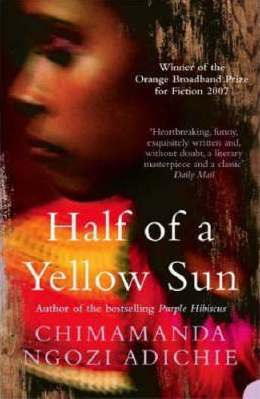
On Reading Chimamanda Adichie’s Half of a Yellow Sun


I confess that I read Adichie’s Half of a Yellow Sun way before I got to read any of her other texts. I am not complaining, just acknowledging where Adichie and I tragically met. But before I can say anything more, I have something to share about her novel Purple Hibiscus: in this text, the narrator says “Jaja's defiance seemed to me now like Aunty Ifeoma's experimental purple hibiscus: rare, fragrant with the undertones of freedom, a different kind of freedom from the one the crowds waving green leaves chanted at Government Square after the coup. a freedom to be, to do” (p16). This bildungsroman novel narrates the story of Kambili and Jaja two kids raised in a semi-contemporary African context by a religious fanatic father. The story tells of their growth – physical, psychological, social – and how they eventually rebel against their father's tyranny. In this story, it is not only the traditions which fall apart, but also the contemporary values that are rootless, aped from alien cultures and without realistic points of reference from which we can identify with. It seems that the text makes a mockery of the colonial education and its shallowness in attempting to assimilate Africans from their ‘heathen practices’.
Hence, Eugene's obsession with the rosary and his repeated reference to his father as a worshiper of heathen gods projects him as an alienated man whose perspective towards life is bereft of any human life. He is thus unhappy, selfish and he fatalistically drives himself to damnation. His wife epitomises “the traditional subservient woman” who answers the call and beckon of the husband but she can’t take it anymore and so she begins to poison the husband until he dies. It is a bold move that sets her apart from what the reader had expected of her as a timid woman. The husband's death liberates her and at the same time empowers her – releases her from the shackles of tradition which prescribes her space as that of a diminished woman who must heed to what the husband says. This is the story of Kambili whose world seems unfathomable from her innocent child’s perspective yet it is powerfully rendered to demystify the lie that is patriarchy.
So what about Half of a Yellow Sun? This novel gripped me, tantalised my taste buds and at the same time scared the wits out of my mind. After all I read it shortly after the bungled 2007/2008 Kenyan elections and the chaos, death etc that accompanied the release of the results. I could not avoid it and so I had to make a connection between the civil war of Nigeria and the 2007/2008 postelection violence in Kenya. The similarity between the two cannot be overemphasised. The beauty of this novel lies in the story of Kainene and Olanna, the twins whose parents are wealthy business people courtesy of a corrupt government structure. The tensions surrounding their school life, love, relationship, and or marriage is what holds the story together even as we discover the political tensions of the nation at large.
The way the personal lives of Kainene and Olanna are shattered, the challenges they undergo to reconnect, to remember their childhood innocence and the experiences that have embellished scars on their lives physically and psychologically are symbolic of the intrigues that characterise the social, political and economic spectre of the nation described in the novel. But, a bigger tragedy lies in the suspicion and the inbred hatred that throbs in the veins of tribal/ethnic hatred and the religious abhorrence that exists between the Christians and the Muslims.
I became hooked to the story as a result of the vividness with which the events are narrated. The descriptions of the characters, their personalities and temperaments left me with a tingling feeling on my tongue. It is as if I could savour them, feel, hear, smell, and touch. The story comes out in a cinematographic manner and I was not disappointed by the trailer to the movie either. In fact, the minute I saw the trailer, I was able to reconnect with the story and to share in the similar images that I had imagined of all along.
Although, it is the bloodshed and the brutality with which the war is waged that portrays the cruel/evil nature of man. That human beings can turn against each other with such gusto, bile and the ferocity of beasts seems out of this world until you observe your alter ego in a moment of anger. The mangled bodies, charred remains and destroyed property appear like a horror movie especially when you come across the people as they massacre one another. The text warns us against bloodletting because a single drop of innocent human blood might be the ingredient that we all need to be reminded that beneath our human skin lies a monster of un-proportional magnitude incapable of being tamed. This is the tragedy that befalls Ugwu, Odenigbo’s naive house boy.
Caught in the melee of the nation’s disintegration and the deteriorating relationship between Kainene and Olanna is Richard, a British Anthropologist. He represents the expatriates who are torn between identifying themselves with their countries of origin and those of their heart’s desires. They are not the only victims of alienation because Mohammed, Okeoma, Madu, Abdulmalik and many others are inexplicably torn apart by the retributions of alienation. It is a story of love, pain, joy, marriage, break up, death, civil strife, culture, religion, business, migration, education and many others all concocted in one melting pot.
I will bet that watching the movie will be nothing close to a reading of the text. For example the description of the little baby girl’s plaited head covered in a calabash cannot be captured in any better way through camera shots as opposed to the manner in which it is vivified in the novel. Thus, I am looking forward for a copy of Adichie’s third novel Americanah to appease my avid taste for her writing. Although, for now I have to sit back with bated breath to wait for the movie Half of a Yellow Sun, but I am already biased because my appetite has been satiated by a reading of the novel. What about you? 

Popular Posts