Monday, July 27, 2015

Re-imagining the Kabaka Kingdom


Jennifer Nansubuga Makumbi’s Kíntu – A History of Uganda
Kwani? has been instrumental in the publishing of innovative stories that reveal a diversity of the wealth of creativity in East Africa and Africa at large. Makumbi’s Kíntu is one such novel that attests to the depth of imagination and creativity from the region. In this text, the reader encounters a fusion of modernity and history as the writer narrates a modern epic characterised by historic fetes, myths, fears and unfathomable cultural transformations as a family tree is reconstructed. This is the story of Kintu Kidda – the Ppookino of Buddu Province in the kingdom of Buganda – retraced from the 16th Century.
The novel opens with a prologue whose setting is in the 21st century. In this prologue, Kamu Kintu is picked from his home by Local Councillors (LCs) only to be murdered a short distance away from his house by an irate mob that accuses him of being a thief. On one hand, it is a precursor to a historic legend – an epic of the Kintu family – that unfolds thereafter as the novel plunges us into the past connecting Kamu Kintu’s death with a legendary curse that has plagued the descendants of Kintu Kidda’s family over the years. On the other hand, it rekindles memories of political disappearances in most African countries; hence, Kamu’s death symbolises both political assassinations and intolerance.
Kintu Kidda’s epic story is entwined with that of his twin wives Nnakato and Babirye. It is a revelation of traditional myths and specific cultural practices entrenched in many African communities. The history of the Kintu family endures the passage of time but so does the curse unleashed on this family by a Rwandese man – munnarwanda, Ntwire, for the loss of his only son Kalema in the hands of Kintu Kidda. The reference to Nwire, a Tutsi man who arrives to take abode in Kintu’s homeland evokes emotions about the rivalry between the Hutu and the Tutsis of Rwanda thereby symbolising the ethnic conflicts in the region. Inevitably, Ntwire accords Kintu’s Nnakato the custody of his only son Kalemanzira to be brought up as a twin brother to their son Baale.
On a fateful journey to pay homage to a new Kabaka – Kyabaggu – as a result of the dethroning of the other Kabaka – Namugala, Kalema is chastised by Kintu through a slap but unfortunately he dies in the desert of o Lwera. The punishment is occasioned by Kalema’s attempt to drink from the gourd of Kintu, an act that is forbidden according to the customs of the Baganda at the time. When Ntwire finally learns of Kalema’s death, he leaves Kintu’s Mayirika – principal residence – distraught and heartbroken. Nevertheless, he utters an unforgettable curse that the descendants of Kintu Kidda have to reckon with for hundreds of years before they can finally regroup in an effort to not only re-establish their roots, but also to appease the spirit of the munnarwanda for the crime committed against him by their ancestor – Kintu:
‘You see these feet,’ then he pointed at his feet. ‘I am going to look for my child. If he’s alive, I’ll bring him home and apologise. But if I don’t find him – to you, to your house and to those that will be born out of it – to live will be to suffer. You will endure so much that you’ll wish that you were never born.’ Ntwire’s voice shook as he added, ‘And for you Kintu, even death will not bring relief.’
Indeed, Ntwire’s words live true to their utterer’s spirit. Through the passage of time, the family of Kintu Kidda metamorphoses and so does the nation of Uganda. Ironically, even though Uganda as a nation strives to weather the storms of colonisation, attains independence and grapples with political upheavals in the form of coup d'états– Iddi Amin, Milton Obote etc. the descendants of Kintu Kidda have never known what to live peacefully means either. The relative calm in the political, economic and social environment of Uganda does little to soothe the curse of Ntwire over the lives of Kintu’s lineage. It is as though their lives are an endless crossing of the o Lwera desert described in the text thus: “However o Lwera was o Lwera. Even at this distance, a dirge, the hum of its heat, was audible. Waves of radiation danced in the air warning: You traverse these grounds at your own peril.”
Jennifer Nansubuga Makumbi - The Writer
Although some of the descendants traverse the world in search of better education and economic prospects, the curse clings onto them as a rude reminder of their roots. Besides, some family members try to escape into Christian religion in the deepest hope that the curse would leave them alone. One of these is Faisi (Faith) and Kanani (Canaan) who adamantly refuse to be drawn into the cultural beliefs of their ancestors. However, they too realise that they cannot wish the curse away as it finds abode in their children – Job (Yobu) and Ruth (Luusi). Consequently, they have to sacrifice their personal interests, like many others of their larger family, to regroup nay to reconcile with their past and to seek peace in their present and future lives.
In this novel, the writer is ambitious enough to weave contemporary events together with those from the past in a seamless manner. It is as if the reader never experiences instances of flashbacks but is always in the ever present moment of the narrative. Amassing many characters over the time, navigating a wide geographical locale and spanning centuries of time, the text ably fuses history and modernity together. New diseases, modern technology and contemporary cultural practices are presented as an inevitable evolution of global trends that have shaped the world over and not just Uganda
Therefore, Kíntu is an epic story that reveals the deeply embedded traditions of the Buganda Kingdom and the birth of the Ugandan nation at large. Through a multiplicity of different family stories, Makumbi seeks to reconstruct the family tree of the Kintu family and thereby the history of Uganda as a nation. As the myths unfold, the unexpected come to live, and the unimaginable happens, the reader is able to reconnect with a past that makes the acts of the present palpable. This is a story that acts as a good reminder that we can never wish the past away since the past inevitably contributes in shaping the future.


Monday, June 29, 2015

Francis Imbuga’s The Return of Mgofu

Replaying Societal Ills on Stage
Image courtesy of Google
Writing within a context of a geographical region troubled by social, political and economic problems, Francis Imbuga chooses to dramatize the society’s malaise in his last play: The Return of Mgofu. Perhaps prophesying about his death, seeing the close proximity between the spiritual world and the physical one we inhabit, Imbuga, partly, invokes on ethereal characters to warn the living that human life is precious and it should thus be unreservedly protected. In particular, Thori and Thoriwa, both husband and wife, adorned in their spiritual bodies have come back as messengers from the land of those who died a long time ago to sensitise the people on the need for good neighbourliness.
As a matter of fact, Thori recalls that: “The only thing necessary for evil to triumph is for good people to do nothing”. Reminiscing about an incident in which clashes broke out; therefore, people getting displaced, maimed and others killed, Thori decries that it is because the good people did not take any action that innocent blood was shed. Contrasting the state of things in the past and the present, the play appears to suggest that human beings have become increasingly intolerant of each other owing to heightened greed for power and the need to control resources for selfish gains.
It is possible to deduce from the play that in the past people lived harmoniously, were friendlier, and loving; thus, in a spirit of communalism they cared for one another selflessly. Although this appears to be a romanticised state of affairs, Thori and Thoriwa affirm the humaneness of their times by declaring that they were keepers of other people’s children although they did not have their own. Perhaps we can surmise that with an increasingly populous society bedecked with suspicion, mistrust, dwindling resources, insecurity, incurable diseases and economically insatiable leaders amongst other calamities, human beings have no choice but to be mean to one another.
However, Imbuga highlights the fact that there have always been good people in our midst, that if they took action against evil deeds we would have a peaceful society to live in. Indeed, Imbuga appears to insinuate that things go wrong in the society because the morally upright are afraid to speak out or to take a stand against those who break the law. Drawing from the ancestral lineage of Mgofu Ngoda, the playwright demonstrates that troubled African nations can revisit their roots, borrow a leaf from traditional values of peaceful co-existence in a bid to tame an otherwise antagonistic trend that spells doom for humankind.
Mgofu Ngoda is a son of the Great half blind Seer who has to make a comeback to his ancestors’ land from which they were alienated by clashes. While others chose to hide in a shrine to escape the mayhem of animosity, the Great Seer argued that: “The strongest oak of the forest is not the one that is protected from the storm and hidden from the sun. It’s the one that is compelled to struggle for existence against the winds and rains and the scorching sun.” This symbolically suggests that African countries experiencing upheavals of varied nature can weather the storm; they can learn from their mistakes in order to lay the foundation of a better future for their people. Ironically, the people who hid at the shrine ended up being burned from the very place they had imagined was the safest – a holy ground. Paralleled to the 2007/2008 violence in Kenya in which some people were burned in a church, the events reveal the disturbing dehumanisation of people and the play’s conclusion that: “If they can burn a place of worship, they are beyond redemption.” 
Image of Imbuga courtesy of Google
The play also conveys political undertones by creatively castigating activities that sugar-coat human misdeed. For example one character decries that “Charity sees the need, not the cause” in a way making fun of countries and individuals who thrive on giving hand-outs/donations instead of addressing the source of the problems. Other issues at the centre of the play’s concern include land clashes and how even priests – individuals placed on the highest moral pedestal – connive to shed the blood of fellow beings. Specifically, the play underscores how technology is sometimes exploited to fuel animosity as local radio stations adopt mother tongue to spread ethnic hatred. This is suggestive of how emerging modes of communication such as social media can negatively be adopted in maligning others, organising terror attacks, syphoning public resources.

In Mgofu Ngoda, we are invited to see the return of good and the possibility of the triumph of good over evil. The reader visualises a new world order in which human beings take charge of their actions. Imbuga’s play envisions a society that is devoid of genocides, one that thrives on political tolerance; a community of people who are selfless in serving and caring for others. In essence, The Return of Mgofu is a call for humankind to return to good practices by shunning ethnic, racial or any other form of discrimination against fellow human beings. It is both Imbuga’s farewell and clarion call to humanity to embrace the triple values of peace, love and harmony irrespective of our gender, cultural, ethnic, racial, political, social or otherwise economic disparities.

Monday, May 18, 2015

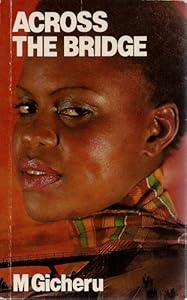
Mwangi Gicheru’s Across the Bridge: A Review

Bridging the Socio-Economic Gap against All Odds

Although Mwangi Gicheru crossed the bridge of life to death in May 2014, it is interesting to note that his texts continue to inspire many people to bridge the gap of literacy though a reading of his novels. Indeed, Gicheru is revered for titles such as: Two in One (1970), The Ivory Merchant (1976), Across the Bridge (1979), The Double-Cross (1983), The Mixers (1991) and The Ring in the Bush (2013). From comments posted on the internet, it is obvious that Across the Bridge has left an indelible mark on the minds of many as an initiatory text into the world of Kenyan literature.
Across the Bridge narrates the story of two young lovers, Chuma and Caroline Wambui, whose social and economic worlds are distinctly apart. Chuma is a house boy serving the family of Kahuthu, Caroline’s father, a civil servant representing the neo-colonial bourgeoisie or as described in the text a black-duke. In this post-independence social setting, interactions between employees and family members of their employer is characterised by a master servant relationship and any cordial relations or attempts at familiarity are vehemently thwarted. Thus, the rich neo-colonial suburbs are depicted as ailing from extreme loneliness since relationships between the servants from different households are also forbidden.
Caroline Wambui, Kahuthu’s only daughter tragically suffers from this set up which denies human interactions amongst the different social classes. As a young schooling teenager, Caroline yearns for friends both male and female, but the father’s hawk eye and security detail denies her the possibility to make friends. Devoid of a human touch, apart from that of her parents, and yearning to quell the heat of teenage emotions, Caroline crosses the social bridge and reaches out to Chuma, the only young man within her reach; albeit, the houseboy with whom she is not supposed to have any second thoughts about.
Chuma considers himself “A factory reject!” because he “[suspects] God must have created [him] shortly before lunch. The lunch bells were ringing when He was making [him]. In a hurry to leave His workshop, He left [him] incomplete. Worst of all, He gave [Chuma] the brain of a chicken and the body of a human.” This sense of dark humour pervades throughout the text providing it with comic relief from the tragic happenings that unfold thereafter. Therefore, in his self-deprecation, Chuma does not imagine that Caroline would cast her gaze towards him since the socio-economic setup bars any possible bridging of the gap between them let alone any physical relations.
However, as the narrator observes: “It was only natural that Caroline, already an adult, and beautiful and lonely, would try to seek the company of a member of the opposite sex.” Consequently, both Chuma and Caroline have to cross the social bridge since “the only man within [Caroline’s] restricted reach was the only man within the home compound. The houseboy named Chuma.” Unfortunately, the heat of their passion for one another is unbridled and Caroline becomes pregnant as a result of their nightly rendezvous at Chuma’s quarters occasioned by bodily explorations under the cover of darkness.
The rest is history. Chuma takes off, Caroline chases after him and Kahuthu is compelled to sue Chuma for eloping with his daughter. Although Chuma wins the court case and is determined to keep Caroline as his wife, it is apparent that he cannot do so within his economic means. Caroline is socialised and accustomed to a high life that is diametrically opposed to the abject poverty in Chuma’s home. Realising that he has crossed the bridge to adulthood and responsibility, Chuma devices all sorts of plans to fend for his wife in a bid to keep her happy as much as possible.
It is the pressure from seeing Caroline’s discomfort, her beautiful face becoming disfigured by the strains of destitution that gnaws at Chuma’s senses and drives him to leave beyond his economic means. Much later when he has mastered the art of pilfering money from his boss’s bar in a bid to make extra income, he blames Caroline for his actions and ambition. He ends up being jailed and within that period Caroline is reunited with her family and shortly after whisked far away from Nairobi to Mombasa.

Chuma’s efforts to track Caroline after his release from jail fuel his desire to finally cross the economic bridge for good. He contends that Caroline has planted the seed for ambition in his heart, a feeling that he says he cannot shake off. Ironically, he gets into bad company with Kisinga, an armed criminal who argues that there is no difference between what he does and what politicians do since they are all thieves; thereby justifying his criminal acts. It is Kisinga who preys on Chuma’s weakness and desire for economic liberation to induct the young man into the world of crime.
Consciously, Chuma crosses the moral bridge when he aids Kisinga to clobber a tourist couple in Mombasa so that they can steal money to finance their way back to Nairobi. Although Chuma had previously engaged in crime, the reader is hopeful that he can be redeemed from deteriorating into full-fledged criminal activities, but after the incident in Mombasa Chuma resigns himself to fate and commits to make money in any way possible. He rationalises that this is the only way to win back the love of his life. He even confronts Caroline and accuses her of planting the seed of ambition in his soul.
A bank heist in which Chuma is involved culminates in his acquisition of a huge chunk of money. In his folly to appear important, to be recognised as a man of means, he makes the mistake of parading himself at a golf club that Kahuthu frequents. Chuma experiences dire alienation and even begins to hate the new identity he has forced on himself. This is worsened by his encounter with Caroline who rejects him even after he has invested so much money to buy her gifts hoping to impress her. A scuffle in a luxurious tourist resort culminates in critical injury of Caroline and eventual arrest of Chuma.
Underlying the narrative are patriarchal insinuations that women are materialistic and their hearts can only be won with material things. In fact, it appears as though the text endorses the thinking that women are the cause of men’s troubles. Although Chuma and Caroline are later reunited, certain moral questions are left unanswered. Is the narrative suggesting that it is alright to steal money and invest it in a good cause thereby sanitising the act? Is it not possible to make money without relying on dirty underhand dealings as is commonly practiced in most third world nations? Are men incapable of working hard to make it in life without women as trophies for their hard work?
Across the Bridge makes for an interesting read by appealing to the popular. It demonstrates the possibility of love between two unmatched teens by way of a thrilling journey characterised by setbacks to their quest to stay close. Excitement in the text builds through their yearning to conquer the insurmountable as both Chuma and Caroline strive to demystify the thinking that the master’s daughter cannot cast her eye on the master’s servant. Although Chuma is to blame for pursuing an unacceptable economic path, the society at large is cast as the main culprit because it harbours social settings which favour certain people at the expense of others. It therefore remains for us to see who would not be willing to go across the bridge of social, political, economic and any other structures that hinder our progress in our desire for self-actualisation. 

I am not yet aware whether any of his texts have transitioned into the movie industry in the form of adaptations. However there was word that Gicheru was working on a script from Across the Bridge before he passed on. It would be exciting to see this alongside adaptations from John Kiriamiti's trilogy. 

Popular Posts