Monday, October 31, 2016

Education in Kenya: Who wants to be a Professor anyway?


(From the archives: Memories from South African Reminiscences in 2014/2015)
Image courtesy of Google images
An interesting spectacle unfolded during the last three days as I attended a doctoral supervision training course at UFS (University of the Free State Bloemfontein) aimed at strengthening and enhancing the quality of doctoral research in South Africa. It suddenly dawned on me that a society’s values are best measured depending on where its money is invested. Suffice to note that a good number of developed economies invest a colossal sum of their money in building human capital through educational programmes. The inverse is true for developing countries whose resources seem to get wasted through a political class hell-bent on attaining highest honours on self-aggrandisement and economic enrichment.
For example, Kenya has a small number of quality doctorates in relation to its population compared to a preferable sample ratio of 100 doctorates per one million individuals. The trickledown effect is that educational standards are adversely affected. As a result, instead of having the most qualified personnel teaching pre-schoolers and early grade children, the reverse is witnessed. In Kenya, the more qualified you are, the less likely you are to teach lower cadres of students. Indeed, most professors are stuck in teaching doctoral students, or handling administrative tasks, thus denying young scholars the opportunity to benefit from their knowledge.
In an ideal environment, a professor should be the one teaching children and helping to nurture and horn the educational skills of a future generation. However, in most developing countries, this task is delegated to people who failed in school because the career is associated with poor pay and lack of respect or recognition. It is thus not surprising to realise that there is a dialectic relationship between the quality of education amongst the majority of people who happen to be poor and their masterly of language skills or other pedagogical matters.
On the contrary, those who can afford to enrol their children in expensive schools, begin to reap the benefits of a quality education system that, so to speak, unfairly advantages their children over those from poor backgrounds. Essentially this means that expensive schools have the capacity to attract and retain highly qualified personnel as opposed to public schools that have to rely on meagre government funding. Thus, it might be possible to surmise that our educational system is largely discriminating and responsible for exacerbating the social stratification of our nation.
What would it take for a country like Kenya to have qualified professors to teach kindergarten kids? As it is, many undergraduates will finish their first degree without imbibing or sipping from the fountains of professors’ wisdom. And therein lies our educational tragedy. I am not in any way postulating that people with master’s degrees or PhD’s are not qualified, no way! My argument is simply meant to underscore the fact that the years invested in research and dissemination of knowledge percolates into the making of the individual thereby making him/her a better academician.
Besides, if the Kenyan educational environment was conducive, apportioning adequate resources in terms of time and money, many people would venture into the profession. Unfortunately, being a teacher in a Kenyan context is something that most of us disdain and look down upon. There is no question that societal demands have pushed many a young person to escape the academic path lest they wallow in eternal miasmic conditions of poverty. It is thus prudent for us to rethink the values of education and to appreciate the different demands that societal responsibilities will exert on us. In this way, we will equip ourselves with different skills and pursue different careers with our heads held high.
Image courtesy of Google images
Indeed, we need to re-invest in the education sector. We need to retrain our children that education is important. Although there are high achievers in the society who are school dropouts, our children need to be in the know that pursuing education does not mean putting one’s goals to an end. Rather, it means that education becomes a means to help them to better focus and crystallise their vision and goals. Maybe it is high time we stopped being paranoid about education and respected this noble profession if we actually belief in the sanctity of human growth and a holistic society.
Back to by doctoral supervision course. At least I learnt one important issue regarding power play in connection to supervision – education can make or break someone’s future! Consequently, if we are not careful, our educational pursuits as a country will end up breaking our kids’ souls instead of transforming them into inspired qualified beings capable of discovering innovative solutions to our social, political and economic woes. I hope that the next time we talk to our kids about what they want to be when they grow up we will think about the need for a quality educational system that can propel them to be what they visualise in their dreams and fantasies.

Wednesday, September 28, 2016

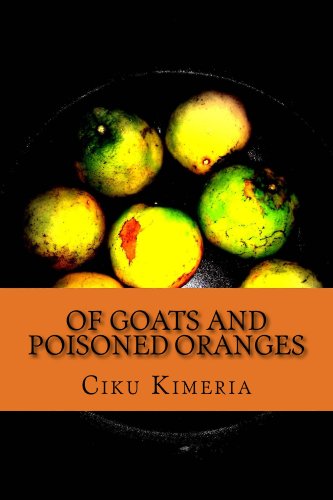
Class Struggles in "Of Goats and Poisoned Oranges"


It is one thing to start a story with a lot of promise and yet another to bring it to a fulfilling clincher at the end. I feel as if Ciku Kimeria’s Of Goats and Poisoned Oranges has left me with a series of unresolved or else loose ends that could have done with some polishing. But who am I that is yet to reconstruct a coherent opening to novel to say so?
Kimeria presents a story whose opening is so riveting that I was at once reminded of Ng’ang’a Mbugua’s Terrorists of the Aberdare. In Mbugua’s case, the story opens when the protagonist has arrived in heaven and is trying to get acclimatised to the new surroundings. For her part, Kimeria borrows a similar but doubly different angle. The narrator reckons: "It really is a strange situation to find oneself in - that of attending your own funeral. If anyone told me that the day would come when I would get to listen to my own eulogy, see old lost friends shed a tear and notice the absence of those I had assumed would be at my funeral, I would have thought them mad."
Of Goats and Poisoned Oranges demonstrates the superficial lives of Kenya’s middle class and pokes fun at attempts to bridge the gap between the low class and members of the middle class. This is vividly brought out in the marriage between Wambui, the novel’s protagonist, and Njogu, the antagonist. It is a fairy tale of a relationship that was never meant to be and one that miserably and tragically comes to an end when Njogu murders Wambui after she physically effaces her existence by feigning her death.
One could argue that this is a modern narrative reliving the times of urban populations and their socio-economic struggles. Njogu marries into money and begins to make an identity for himself. Unfortunately, this is overshadowed by his poor upbringing and the fact that he has married into a rich family. Consequently, he is not Njogu the man he would wish to be but the Njogu married to Wambui. It is a crisis of identity that drives him into seclusion when his marriage first alienates his family and friends and then forces him into a stage-managed lifestyle that he loathes. One could even propose that he feels emasculated as a man.
The unfolding of the story reveals the different life perspectives modern couples have as a result of their upbringing and the kinds of tussles this can create. Told from a multiplicity of voices, Of Goats and Poisoned Oranges allows each character to reveal their inner desires and fears by telling it all – the bare knuckle way. The conflict between Wambui and Njogu is given impetus by the appearance of Nyambura, Njogu’s mistress, in the picture.
A few flashes of suspense will keep the reader going as s/he strives to find out how the trickery of the couple upon each other will turn out. The lies that married couples keep are unravelled and the reader is made to reassess his/her postulations about marriage. Indeed, the text revels in the stereotype that a nagging wife is the sole bearer of the responsibility for her cheating husband. It also preys on the thinking that a couple can be discordant if the lady is rich and the man is poor. But you have to read the novel and decide for yourself.
However, I must give the story credit for the fact that it gives women a kind of agency. Although it is not well captured/brought out, one feels that the women somehow have a sense of control over their bodies, that is, their sexuality. The fact that the women also have money, apart from the few who have to rely on the men to provide for them, attests to the fact that women are consistently getting economically empowered in contemporary urban societies.
One of the best ways in which the women demonstrate independency is when they choose to have children without letting Njogu know that he is unable to sire. Hence, King’ori and Njogu jr. are not sons of Njogu, at least not in a biological sense. In this way, Kimeria enables the women to decide how they will be defined in their own terms. But I fault the text for being artificial in the way it tackles perceptions about poverty. I felt like the writer tried too hard to capture the sensibilities of a poor man and his ambitions. The descriptions about Kibera come across as too shallow and devoid of any meaningful depiction of slum dwellings.
One will have to grab a copy of the text to be their own jury. For me, it is just another read not necessarily for critical studies but one that can help to while away the time. It is not necessarily humorous but some may find it so on the contrary. I trust that you will enjoy it.

Thursday, September 22, 2016

The Dark World of Fiston Mwanza Mujila’s Tram 83


Not necessarily a fast read for me but I am nevertheless quenched since I have put to rest Mujila’s Tram 83. This is an interesting novel grappling with the underworld of a third world country torn apart by greed for minerals, power, money, that is, that innate desire in human beings to have control over others. This is a story set in a bar but conjuring up the essences of political war lords, creative writers, drunkards, prostitutes, miners etc.
This is the story of the people of the Democratic Republic of Congo. It is a projection of what a failed leadership leads to. It depicts the tale tale consequences of civil war, the enlisting of minors into forced labour in the mines, the debauchery of the society as minors are forced into prostitution and the general moral decay occasioned by the disillusionment of a socio-economic set up that is lopsided.
The opening chapter of the text provides a vivid picture of what the reader expects to encounter:
“IN THE BEGINNING WAS THE STONE, AND THE STONE PROMPTED OWNERSHIP, AND OWNERSHIP A RUSH, AND THE RUSH BROUGHT AN INFLUX OF MEN OF DIVERSE APPEARANCE WHO BUILT RAILROADS THROUGH THE ROCK, FORGED A LIFE OF PALM WINE, AND DEVISED A SYSTEM, A MIXTURE OF MINING AND TRADING.
Northern Station. Friday. Around seven or nine in the evening. “Patience, friend, you know full well our trains have lost all sense of time.”
The Northern Station was going to the dogs. It was essentially an unfinished metal structure, gutted by artillery, train tracks, and locomotives that called to mind the railroad built by Stanley, cassava fields, cut-rate hotels, greasy spoons, bordellos, Pentecostal churches, bakeries, and noise engineered by men of all generations and nationalities combined.
It was the only place on earth you could hang yourself, defecate, blaspheme, fall into infatuation, and thieve without regard to prying eyes. Indeed, an air of connivance hung ever about the place. Jackals don’t eat jackals. They pounce on the turkeys and partridges, and devour them. According to the fickle but ever-recurring legend, the seeds of all resistance movements, all wars of liberation, sprouted at the station, between two locomotives. And as if that weren’t enough, the same legend claims that the building of the railroad resulted in numerous deaths attributed to tropical diseases, technical blunders, the poor working conditions imposed by the colonial authorities – in short, all the usual clichés.” (pg 1-2)
Indeed, the lives of Requiem and Lucien symbolically reflects the weight of this statement: “It was the only place on earth you could hang yourself, defecate, blaspheme, fall into infatuation, and thieve without regard to prying eyes.” The opening line of the text alludes to the Bible and the creation story. Mujila draws on this to ironically problematize the struggles of the people of the Democratic Republic of Congo to not only put their lives together but the very being of their nation too.
This is the kind of story that wrenches a reader’s heart apart as we encounter baby chicks coerced into prostituting their bodies so as to survive. The efforts to make a living under whatever cost draws people in droves from all corners of the world. Rivalries abound, pimping takes centre stage, honesty and truth become an anathema and the human life is reduced to something that can easily be dispensed with. In dark humour, Mujila pokes fun at the people’s efforts to enrich themselves whilst openly disregarding human beings who end up being destroyed in the process.
The narrative texture and linguistic choices are inventive. There are sections of long paragraphs of one sentence, an isolated case of repetitive use of a single word in one paragraph and other uncanny literary choices that make the text unique. The music played in Tram 83 is a mixture of different genres but jazz abounds. In fact, one can argue that the music helps to drown the people’s sorrows just as much as the drugs, sex, extortions, and the drinking sprees do. It is an adventurous narrative that bespeaks of neo-colonialism and perpetual exploitation that has remained the bedrock of most postcolonies.
Tram 83 is a story of the jungle that is African states afflicted by failed leadership. The chaos that characterise the story are best depicted in the cranky nature of the narrative. The paragraphs appear to be characterised by a rough texture of crude language, obscenities, and a general air of perversion. In this way, Mujila successfully depicts the seedy underbelly of a country besieged by a reckless gold rush that can only resort to pure anarchy.

Popular Posts