Monday, September 1, 2014

Why we should Read for Entertainment’s Sake

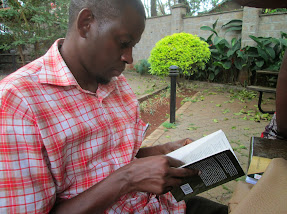
Reading "Dust" during a Daystar Book Club Meeting 
There have been substantial debates regarding the reading culture in Kenya today. Most of these discussions, if not all, squarely lay the blame on the current system of education and a generation Y that is allergic to reading. Whether such observations are true or not should not bother us so much as we should be by the lack of reading for leisure among the general populace.
When we hosted StoryMoja Festival’s Ideagasm session in Daystar University last week, I was confronted with startling remarks that jolted me back into the reality of what ails our reading culture. Some of the questions that were raised in the discussion included: What are we reading? What do we want to read? What are we writing? Why are we not telling our stories in film and in literature? What is the fear that plagues us?
The questions sparked off a spirited discussion that essentially accused the literary critic of not inspiring a critical mass of readers. Apparently, literary critics, I included, are fond of using complex theoretical phrases and diction that puts off general readers. I am not arguing that Kenyans lack the mental capacity to interpret such scholarly language but rather I am taking note that book reviews should be written in a way that would excite a majority of readers to yearn to read for fun.
A part of those present observed that Kenyan literary critics limit the scope of their audience by targeting each other. These critics hardly make any effort to describe the texts in simple and interesting approaches that would appeal to a wider section of Kenyans. As a result, most book reviews end up being counterproductive because the readers don’t see the texts as a source of entertainment.
Owing to the education system, most of us dislike literary texts because of the high school set books. The system is such that students are drilled to read to pass exams and the same applies to literature. With limited time for play and other leisure activities, the students develop a negative attitude towards reading thereby disliking literature as well. We cannot also discount the fact that books are expensive and that those who teach the subject may not have interesting ways of engaging the young minds to learn to appreciate the arts.
As a result, poor reading habits are extended to our homes. The contemporary society appears keener on making ends meet; thus, there is little or no time at all to nurture a reading culture. We have to create time to read not because we will be examined but simply to indulge in the pleasures of the text. This process will require that we read basically for entertainment: to enjoy the thrills of the story, to connect with the characters, to discover the lessons, to admire the choice of words, to marvel at the descriptions, adventures etc.
Probably, if we chose to read on such basis and not for themes or stylistic devices, then we might begin to fall in love with literature. We should also avoid general categories of texts such as serious and popular which at times discourage some readers from reading. There is an assumption amongst some people that reading a popular novel is inferior; but, reading Achebe should be as exciting as reading Sheldon.

Ultimately, we have interesting stories to tell through novels, paintings, graffiti, dance, music or even film. Thus, if we decide to embrace our diverse interests, both academic and non-academic, when reviewing arts then we will achieve the true spirit of literature. 
The article also featured here: http://mediamaxnetwork.co.ke/peopledaily/95691/reading-books-fun-bad/

Friday, August 15, 2014

A Walk through the Criminal’s Underworld

It is one thing to commit a crime but it is a totally different thing to confess to having committed that crime. A reader’s interest is thus greatly aroused by a text that boldly declares a writer’s indulgence in crime. This trend commonly features amongst Kenyan criminal writers.
John Kiggia Kimani’s Life and Times of a Bank Robber is testimony of the persona’s engagement with and about crime. It is the story of Kimani’s life from a time of innocence in his childhood to his experiences as a criminal in teenage and adulthood. The autobiography reconstructs Kimani’s early life experiences and shows how these sow a seed of a life of iniquities in him.
As a young boy, Kimani confesses to having been thrust into adulthood responsibilities without his consent: “I was forced by circumstances to go to Nairobi when I was barely twelve”. Because his father gets captured along with other Mau Mau members, Kimani is obliged to travel to Nairobi to pick up his father’s property. This serves as a good reason for him to visit Nairobi a place that he has already fallen in love with: “I had made up my mind that the city was my place”. He is ensnared by the glamour and glitter of the city.
Unfortunately, the persona is not privy to the fact that beneath the city’s glamour lurks a world of unequal opportunities built around colonial discrimination and hatred for the Mau Mau sympathisers. When Kimani attempts to make ends meet in the city, he finds it arduous and he ends up being easily lured to engage in business ventures that drive him into crime.
One of the businesses he tries his hand in is a hawking business. It is reminiscent of the power games that hawkers and city council askaris engage in within Nairobi today. Although he later tries importing bananas from Uganda, Kimani admits that the enticement of crime money is more potent than any other source of income. Macharia, his “worthy lieutenant” not only initiates him into crime, but also tutors him to master the survival techniques especially dodging police dragnets.
Kimani gangs up with other criminals and although he starts off with petty crimes like selling stolen goods, picking pockets, and car break ins etc., he eventually graduates into a hard-core criminal. Thereafter, he becomes their leader and commandeers his gang to conduct bank heists. It is interesting to note that the transition from petty crime to armed crime is carefully described with an adventurous spirit that resonates with the reader and makes it possible for him/her to believe in Kimani’s story.
This is a story of a chequered past and a traumatic childhood exacerbated by colonial prejudice. It forms part of the rationale that Kimani uses to justify his deterioration into crime. Growing up and seeing the white settlers having everything in abundance whilst his people wallowed in abject poverty serves to fuel his prejudice against them. It is no wonder that the white people end up constituting a big part of his victims as he commits crime as part of wreaking vengeance against an unjust system.

However, it is Kimani’s spiritual reflections whilst in prison that helps him to transcend the shortcomings of crime and punishment. During his prison sentence, he realises that there are many more criminals in society like cruel prison warders. As a result, he develops a contrite heart and triumphs over crime. Thereafter, he emerges as a transformed man and reintegrates back into the society to lead his life as a redeemed soul.  
PS: This article was first published by The People Daily and is available here: http://mediamaxnetwork.co.ke/peopledaily/94380/walk-criminals-underworld/

Monday, August 4, 2014

Meja Mwangi’s Going Down River Road

It was first published in 1976 but Meja Mwangi’s Going Down River Road is still as relevant as it will be for centuries ad infinitum
This is because the text tackles human conflict that is centred on universal economic inequalities rife in urban settings. Reminiscent of an emerging Kenyan nation grappling with newly found independence from colonialism, the text abrogates itself the duty to serve as the watchdog of the less fortunate in the city. 
It traces the life of Ben Wachira and his dishevelled buddy, Ocholla, as they struggle against all odds to eke out a living as construction workers for Patel and Chakur Contractors. It is a demeaning job that reduces the casual labourers to objects who can be hired and fired at the whim of the employer.
Wachira appropriately describes their identity at the construction site as “Hands” and bemoans that “That is what they are here…if the contractor would make hands, he would never need labourers!” By identifying the labourers as hands, the contractor dehumanizes them and this makes it possible to exploit the labourers since they are not appreciated as fellow human beings. 
Thus, they inhabit backstreets, slums and other poor tenements where moral decay is the nemesis of an upright life. Mwangi’s text posits that unbridled urban growth that ignores the welfare of the people is doomed. The moral fabric of the society described in this novel teeters on the verge of disrepair. 
The women are objects of sexual gratification or simply bastards who are a pain in the arse of the men as Ocholla curses his wives and blames them for his miserable life. Ocholla describes his family as comprising of “Two beastly wives…and the devil knows how many little brats.” This serves to demonstrate the economic challenges entrapping the men and alienating them from their rural homes and families.
Urban life is also characterised by bitterness, revenge, violence and prostitution. Ocholla considers all harlots in Eden as his and the reader is privy to the many occasions in the text where women are willing to sell the bodies in order to make ends meet. Prior to meeting Wini, Wachira is seen scouting for a quick lay and long after Wini abandons him and her bastard child, Baby, Ben deteriorates to engaging with prostitutes to satiate his sexual desires. 
The spectacle is so bleak that at one time Ben engages a fifteen year old prostitute in sex whilst her one old month baby is tucked in a carton in the same room. Moreover, the story highlights the consequences of personal misdemeanour. Wachira is fired from his job as an army lieutenant when he entangles himself with criminals. His downfall culminates in losing a job at the PanAfrican Insurance Company. 
One of his former army colleagues, Onesmus or One-Arse-Mess, holds a grudge against Ben for their lost jobs. His desire to avenge their dismissal his clouded by his abuse of drugs and he ends up being ‘accidentally’ killed by Ocholla who is scared for Ben’s life after the former attempts to run Ben over with his truck.
Ultimately, the novel paints a grim picture of urbanisation although through Wachira and Ocholla we are able to glimpse a glimmer of hope. Ben demonstrates a sense of rational reasoning despite his frustration and at times resigned attitude towards life. Although healthy human relationships are hard to build, the genuine bond between Wachira and Ocholla serves to give the text a sense of hope. Towards the end, Wachira chooses to educate Baby and Ocholla welcomes his rural family to the city. 

Article first appeared in People Daily under the title: Competing for survival in Nairobi City and can be found here: http://mediamaxnetwork.co.ke/peopledaily/?p=93137

Thursday, July 31, 2014

Triumph over drinking to inspire others

Chris Lyimo’s My Side of the Street: One Man’s Journey from Alcoholism to Sobriety
Although Chris Lyimo’s My Side of the Street: One Man’s Journey from Alcoholism to Sobriety may not be adopted as a literary text for study in the classroom, it is one that literary critics should pay close attention to. It is a narrative on masculinity, a misgiving about definitions of sex and gender, a scathing attack on the institution of parenting and above all a clarion call to the society to rethink the essentials of education. Lyimo’s narrative bares it all and strips the reader off any prejudice about matters alcoholism, suicidal tendencies and sexuality.
My Side of the Street is the cry of a lone man abandoned by the very society he thought would not only hold him accountable to his deeds but embrace him and cajole him in the true sense of the words. Lyimo indicts the society for failing him at the moment that he needed a pillar to lean on the most. The absence of a father in his life compounds his socialisation and makes us realise that we are to blame for the failings of our mentees. The genesis of his problems is traceable to his elder sister’s ignorant comment when he is seven years old: the persona is crudely identified by his phallus when the sister intones “Your kanyamu does not look like theirs”.
It is the discourse of exclusion that sets off his life’s path into a trajectory reminiscent of hopelessness and the ever present feeling that whatever the persona attempts to do will ultimately lead to rejection because his kanyamu is different. At this tender age, the persona discovers that his penis, genitalia so to speak, the only body part differentiating him amongst his siblings is the cause of his desolation. He craves to belong, to feel wanted but, unfortunately no one seems to get through to him. The fact that he is the only patriarch in his family makes it worse because of the dented masculine images that hover like a phantom in their homestead. Meet the author: https://www.facebook.com/chris.lyimo
The process of mentoring that would have bailed him whilst growing up is severely challenged. Possible male figures who would have waded in the soles of his father’s feet are losers in their own ways. The cumulative verdict is that he is a loser because men in the family are losers. Sadly, the persona is cocooned in his fragile male ego and things get worse when he indulges in alcohol in the hope that he can get a firm grip of the elusive masculinity – andurume – “the men”.
Confessions are rife in this narrative. The urgency with which the story unfolds makes it vivid and scary. The persona’s struggles to overcome addiction, suicidal thoughts and other negative images on masculinity, marriage and sex serve to demonstrate that it is only an individual’s realisation of their spiritual being that can help to turn their life around. It is a journey of acceptance, a belief in brokenness, worthlessness etc. it is a moment of reckoning that life is worth reconstructing.

My Side of the Street demonstrates redemption and the existence of God. It is a religious narrative coloured by a life of iniquities and other despicable human acts. But it is also a simple story of growing up, falling in love and discovering the first kiss. The narrative has enough lessons for all of us and most importantly it lets us know that there is a haven for every drunkard just as there is a heaven for every sinner as long as one has a strong will to get there. This article was fist published in People Daily: http://mediamaxnetwork.co.ke/peopledaily/?p=91091

Monday, July 7, 2014

The Travails of Kenyan Education

Image Courtesy of: http://alivecampus.com/wp-content/uploads
The psychological and economic exertions of academic pursuits in Kenya cannot be refuted. Although this is not a preserve of developing countries, it is only fair to argue that it is more challenging to attain higher education in an underdeveloped economy as opposed to a developed one. It is likely that developed countries have put in place contingency measures to facilitate learning and research work because they understand the indisputable position of education in shaping human livelihoods. Developing countries, thus, seem to have reneged on this responsibility or taken it for granted.
In 2007 I missed a golden opportunity to relentless chase a DAAD scholarship opportunity and probably learn from some of the best institutions in the world. Blame this on personal error, a miscalculation on my part or being misled by naive and immature love, but the truth is in a blink of an eye I had lost the intellectual opening which would have economically handled my educational prospects. As a result, I went back to my alma mater as a prodigal son and begged to be taken back. At least I could pursue my costly PhD programme at a manageable pace.
I don’t consider myself a bright student by any measure. What I know is that growing up was decorated by financial upheavals and my parents endlessly reminded me that my economic salvation lay with education. It was a psychological and spiritual battle as my young mind strove to make sense of a world of inequalities. I miraculously survived high school and through the benevolence funds of HELB attained my BA degree from the University of Nairobi. Never mind the fact that I am currently paying the last of the instalments of that loan after almost fifteen years later.
At the time I finished my BA degree at least the University of Nairobi had an educational programme for supporting first class honours students to pursue their MA degrees. It is through this arrangement that I attained by MA in Literature. I was not surprised that when I went back to HELB for more funds to pursue my PhD I was turned down. I had never started servicing my undergraduate degree loan! With a missed DAAD opportunity my last fortress was the bank. I may not be able to enumerate the number of banks I visited but one thing is clear about the credit system in the country. If you are not permanently employed or into a business then there is no bank, worth its name, that would transact business with you.
Somehow I enrolled for my PhD with scrapings from here and there. When I essentially became a permanent employee of Daystar University in 2010, after almost five years of part time teaching, I saw the door to cementing my education. Because Daystar has no dependable financial kitty for higher learning for its staff development programme, I took the riskier path and went to the bank once more. My bitterness with an unforgiving economic environment and a country without proper support mechanisms for education transformed me into an introvert. I never even applied for study leave or reduced workload from my employer. When you are a new employee you generously understand that these are not your preserves.
The fact that I completed my PhD studies under duress cannot be underscored. I empathise with all learners and academic enthusiasts who have to contend with lack of educational structures of whatever kind in their quest for knowledge. It is a herculean task that can’t and will never be single-handedly managed. As a society, do we care about education? Do we support those in need of it? My verdict is maybe we care but no we don’t support those in need of education.

  *This article was earlier printed in Daystar Connect, a Daystar University Publication. To purchase a copy, contact the Corporate Affairs Department at pr@daystar.ac.ke.

Saturday, July 5, 2014

Social media: a blessing or a curse to institutions of higher learning

Images courtesy of https://encrypted-tbn0.gstatic.com/images
The wealth of communication possibilities available through social media is unmatched. However, there have been concerns raised regarding the effects of social media on learning in the universities. A good number of these effects are positive but there are as well negative impacts accruing from students’ interaction with social media. For example, the social media platform provides unbridled socialisation through which instructors and students can become innovative and imaginatively recreate better learning models. They can do this by posting questions, engaging in online discourses and where possible sharing their research findings and insights for enhanced knowledge dissemination.   
Social media interactions can also improve students’ critical thinking skills. This can best be illustrated by the fact that social media encourages collaborations as opposed to individualistic approaches to problem solving. An online group discussion therefore provides a student with divergent views that require him/her to digest proffered options before making a decision thus horning out the student’s power to examine scenarios before drawing conclusions. Moreover, social media provides an avenue to use graphics, personalise work and adopt other appealing tools that can exceedingly serve to rope in students into subjects that they had initially expressed disdain for.
Furthermore, it is possible for students to integrate classroom learning with peer interactions amassed from outside classroom contexts. This can be argued to be a positive element that serves to prepare the students for situations that demand skill application as opposed to mere theorising. Also, if properly utilised, social media can provide enhanced interpersonal skills and a feedback mechanism that can make it easy for instructors to monitor student progress and provide personalised engagements for the benefit of the learners.
On the contrary, social media can be detrimental to education in institutions of higher learning. If incorporated into the curricular, the instructors might make the assumption that the social media types they adopt are convenient for their students. This is not necessarily true because we all have varied interests and our knowledge of computers and other modes of technological interactions are different. In our case, it is possible that required gadgets for social media use may not even be accessible let alone affordable.
Images courtesy of https://encrypted-tbn0.gstatic.com/images 
Chances of students getting distracted from the core business of the course are high and prevalent. The assumption is that social media is highly stimulating and both the instructors and learners can get swayed especially when they are actively engaged in online learning. Such off-topic engagements can derail the learning outcomes and eventually affect the students’ GPA. This means that students will essentially find it difficult to finish assignments and their course work thereof. Also, social media thrives on truncation of words owing to space limitations and students’ language skills are consequently impaired by the repeated use of corrupted codes of communication.

In addition, social media is difficult to regulate and one cannot overrule the chances of cyber theft, bullying, abuse, plagiarism etc. There are of course other forms of addictive behaviour like gaming, chatting, or possibly pornographic engagements. But, technological advancement is here to stay and these challenges cannot be wished away. Thus it is prudent for educators to adopt a hands-on-approach to the use of social media and ensure that the learning process is not only collaborative but one that encourages creativity even as it sustains academic integrity. 
  *This article was earlier printed in Daystar Connect, a Daystar University Publication. To purchase a copy, contact the Corporate Affairs Department at pr@daystar.ac.ke.

Wednesday, July 2, 2014

Tasting the Forbidden Fruit in the Garden of “The Stone Hills of Maragoli”

Courtesy: www.peopledaily.co.ke 
Stanley Gazemba’s “The Stone Hills of Maragoli” is reminiscent of Adam and Eve’s transgressions in the Garden of Eden when they chose to savour the forbidden fruit despite having a wide variety of fruits to pick from. But, unlike the Garden of Eden where Adam and Eve had unlimited access to the fruits and provisions of the garden, Ombima in Gazemba’s text must not covet that which does not belong to him – Madam Tabitha. Tabitha is the wife of Ombima’s master and employer Andimi who owns a vast garden characterised by plenty of crops and fruits.
This is a story of inequities. It is a blend of the urban and the rural. A story of fading African traditional cultural practices and the emergent mixed cultural milieu characterised by loose personal relationships and wanting moral values. Andimi is cast as the thrifty business man who has painstakingly invested in building a local empire in the village. Andimi’s homestead is clearly foregrounded as a castle in the backdrop of the wretched village huts that appear like they can cave in at any moment as symbolised in Ang’ote’s dilapidated thatched hut.
Gazemba traces the story of Ombima and his travails as the novel’s protagonist. Ombima’s nuclear family betrays the effort to represent a village life setting since traditionally families would have an average of about ten people in the nuclear family and many more through the extended filial bonds. However, it could also be reminiscent of the shift from the traditional lifestyle to a more modernised mode of life. The serene ambience in Ombima’s homestead is shattered by the death of his only daughter – Saliku – who has been ailing since birth.
Suffice to note that the novel is characterised by elaborate descriptions which cast the story’s setting as a romantic paradise unadulterated by the corrupting ills of mechanization and industrial development. The villagers till their tiny farms and supplement their day to day needs by being casual labourers in Andimi’s farm. Their main chores are tea picking and delivering the produce at the local weighing station. It is a typical farm life commandeered by a foreman in the name of Mudeya-Ngoko, and coloured by the petty jealousies of the labourers as they jostle to find favour either in the foreman or the owner of the farm.
The greatest turbulence in Gazemba’s The Stone Hills of Maragoli happens when Andimi’s wife rocks the proverbial ship after she becomes unhappy with her husband’s obsession with the business franchise as opposed to their marriage. It becomes the same old story of an unhappy wife who falls in love outside marriage, for example, Lady Chatterley’s Lover by D.H. Lawrence, Leo Tolstoy’s Anna Karenina and Gustave Flaubert’s Madame Bovary. All these texts express disillusionment with married life and cast it as dull and listless. It is thus adequate to surmise that Gazemba borrows from this tradition of realistic narration to domesticate the ups and downs of a rural Kenyan village life.
Ombima never thinks nor imagines of an affair with Madam Tabitha. As far as he is concerned, Tabitha is way beyond his reach but when Ombima breaks the law and steals vegetables from Andimi’s garden she takes advantage of her knowledge of his misdemeanour to engage him in an illicit affair without the knowledge of her husband. It is Tabitha who initiates the relationship and dictates the direction of their uninhibited romp. In this context, Ombima is an unwilling party who nevertheless has to dance the marionette dance as long as Madam Tabitha holds the reigns of the strings to their affair. Tabitha’s power and economic standing casts her as possessing an intoxicating and magnetic pull that is characterised by her perfume and one from which Ombima’s weak protestations cannot help him wiggle out of.
It is a relationship that catapults Ombima into turmoil by throwing him of course in as far as being a man in his family is concerned. He becomes a little reckless and he feels unable to provide a sense of proper direction in his family. When Saliku eventually succumbs to her death, Ombima deteriorates in his moral standing. He seeks for solace in smoking and the burden of his inequities towards his employer weighs heavily on his moral conscience. His attempts to ward off the Madam are unsuccessful and he ends up entangled in the sweet aroma of their escapades as they indulge in the steamy and unbridled partaking of the stolen fruit. It is these escapades that take them up to the stone hills of Maragoli from which the novel’s title is borrowed.
Like in the predecessors’ stories of unlawful affairs, this story also ends tragically. Ombima cannot bear the guilt of his relationship alone and he ends up unburdening his soul to his closest friend – Ang’ote. But the jealousies play out and become exaggerated when Ang’ote considers this information as his only sure way out of poverty. Ang’ote confides in Rebecca – the old widow – that he plans to inform Andimi of the escapades of his wife so that he can find favour with him and earn his way up the ladder to riches and a good life. Although Rebecca cautions him against such an undertaking, Ang’ote still goes ahead and breaks so to speak the brother code by betraying his friend. Ang’ote’s decision to report his best friend demonstrates how poor male labourers’ hold voyeuristic gazes towards their rich madams and how they wish to conquer them by indulging in fantastical erotic sexual imaginations.
It is a catastrophic turn of events as a scorned and irate Andimi vows to gorge out Ombima’s eyes for having used them to covet after his wife. The irony of the turn of events is that Andimi had made a personal pact with himself to spend more time with his wife as a way of atoning for his absenteeism. He has vowed to become more loving and to try to reignite the fire that first brought them together. It is however a little too late because Madam Tabitha has become obsessed with getting married to Ombima. The story cautions us about human relationships that are founded on weak foundations since we discover that Andimi had married Tabitha in order to climb the economic ladder by gaining access to business opportunities that her father had.

At the end, it is Madam Tabitha who bears the brunt of her husband’s jealousy and hatred for Ombima whom he considers as a useless servant who should have never dared to do what he did. Andimi succeeds to gorge out Ombima’s eyes but his wife is killed by a watchman’s arrow who is scared that thieves might be plotting to rob the school. Thereafter, Andimi expresses his interest in making his faithful servant his wife now that Tabitha is gone. The tragedy of the turn of events at the end of the text is appeased in that Ombima’s wife – Sayo – is reunited with him and Aradi – his son – becomes his eyes whilst leading him around town to beg for alms. On one hand, this scenario brings the text’s unity into focus since the beginning of the novel had highlighted another old man led by his grandson.  On the other hand, when the two blind men meet again at the end of the novel, the story can then come to an end on a positive light although no one knows whether the peace of the stone hills of Maragoli will ever be assuaged.
The story fist appeared here: http://mediamaxnetwork.co.ke/peopledaily/88976/tasting-forbidden-fruit-stone-hills-maragoli/

Popular Posts